


ARMORY SCALE WEIGHT: Every disc is individually weighed by Armory. Our measured weight may differ from the manufacturer's sticker, embossing, or marked weight.
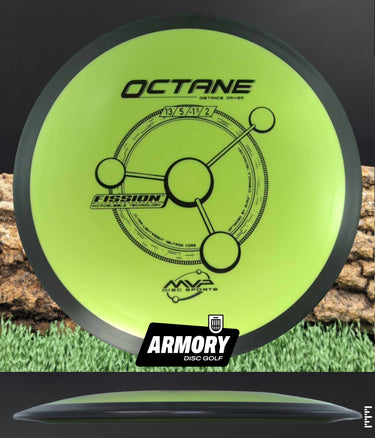
The MVP Fission Octane (13/5/-1/2) is a lightweight version of MVP's 13-speed distance driver. It's the easiest Octane to get up to speed.Couldn't load pickup availability
MVP Fission Octane 13 | 5 | -1 | 2
The MVP Fission Octane is MVP's 13-speed distance driver in their lightweight Fission plastic. The lighter weights make it a lot easier to get up to speed, so it's the Octane to grab if you don't throw very hard. Stronger throwers can still hyzer flip it for max distance. You'll find it in our MVP Octane Collection and our disc golf distance drivers collection.
Flight Numbers
MVP rates the Octane 13 | 5 | -1 | 2. It's from MVP's 23mm-rim distance driver class, and it's built to be more stable than the 21.5mm Wave. For average arm speeds it flies straight with a little turn and a reliable fade at the end. Stronger throwers can hyzer flip it for max distance, throw it on a slight S-curve, and lean on it for tailwind drives. It's not a beginner driver. You need some speed to get it to turn and glide, or it'll just fade out early.
| Speed | Glide | Turn | Fade |
|---|---|---|---|
| 13 | 5 | -1 | 2 |
The Fission Octane is great for:
- Easier distance at slower arm speeds
- Max distance drives on open holes
- Hyzer flips for distance
- Tailwind drives
Fission Plastic
Fission plastic has tiny air bubbles mixed into the middle of the disc. That makes it lighter and puts more of the weight out on the GYRO rim, so it spins and glides well even in lighter weights. Lighter Fission Octanes fly a little less stable than max-weight ones. It's grippy and durable like MVP's other premium plastics.
How the Octane Fits in the MVP Lineup
- Vs the MVP Neutron Octane: The standard Octane in MVP's main premium plastic. Grippy, durable and a good place to start.
- Vs the MVP Proton Octane: MVP's clear, stiff Proton plastic. It's the most durable Octane, so it holds its flight the longest.
- Vs the MVP Plasma Octane: Metallic Plasma plastic that feels a little softer and tackier, nice in cold weather.
- Vs the MVP Wave: The Wave (11 | 5 | -2 | 2) is slower with a narrower rim and more turn. It's easier to throw, while the Octane is faster and holds up better when you throw it hard.
- Vs the MVP Photon: The Photon (11 | 5 | -1 | 2.5) is a slower, more stable driver that fades a little harder. Grab the Photon for control and headwinds, and the Octane when you want more distance.
- Vs the Innova Destroyer: Both are 12 to 13-speed drivers with a little high-speed turn. The Destroyer fades a little harder, while the Octane glides a bit longer before it fades out.
MVP Octane Release Information
- Flight Numbers: Speed 13 | Glide 5 | Turn -1 | Fade 2
- Disc Type: Stable Distance Driver
- Plastic: Fission (lightweight premium)
- Dimensions: Diameter 21.2 cm | Height 1.7 cm | Rim Depth 1.2 cm | Rim Width 2.3 cm
Frequently Asked Questions About the MVP Octane
What weight Fission Octane should I get?
If you don't throw very hard, go with something in the 150s or low 160s. It'll be easier to get up to speed and turn a little more. Heavier ones fly a little more stable.
What's the difference between the Octane and the Wave?
The Wave (11 | 5 | -2 | 2) is slower and turns more, so it's easier to throw. The Octane (13 | 5 | -1 | 2) is faster and more stable, so it holds up better when you throw it hard and in a little wind.
Is the Octane good for beginners?
Not really. It's a 13-speed with a wide rim, so it takes some arm speed to fly the way it should. Newer players will get more distance from a slower driver like the Wave or a lightweight Fission Octane.
Looking for a different plastic or weight? Check out the full MVP Octane Collection Hub or browse all of our MVP discs to pick your exact disc.
